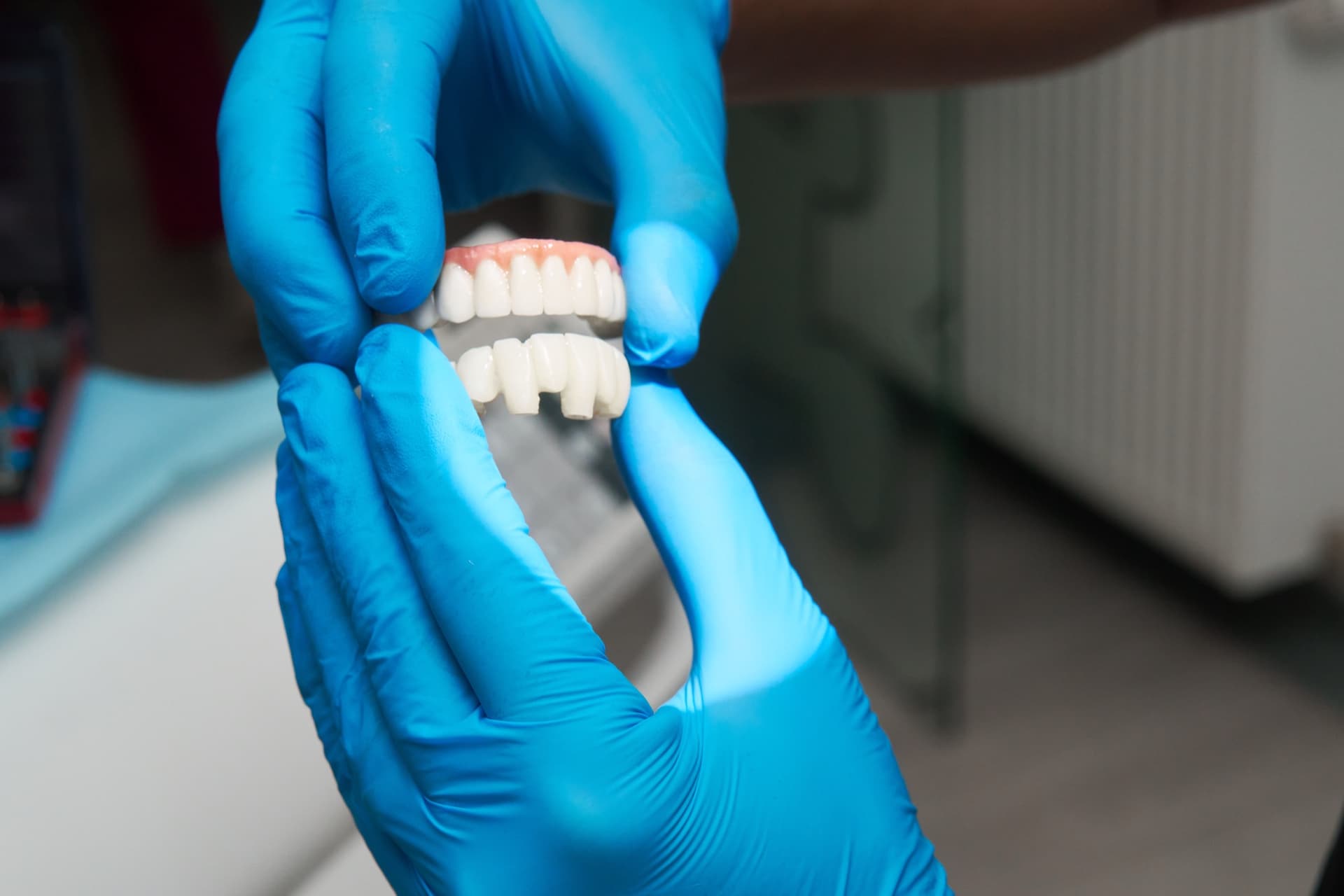
Whole, functional teeth again, with a dental restoration made for you in Sibiu
A broken, weakened or missing tooth is not something you have to learn to live with. A crown, a bridge or a full implant-supported restoration gives it back its shape, function and appearance, so you can chew, speak and smile just as you would with your natural teeth. At Infinite Smile you'll find the full range of prosthetic solutions, from a single crown to fixed teeth on implants.
- Zirconia or metal-ceramic crowns, matched to your case and your budget
- Dental bridges, removable dentures and fixed implant-supported restorations (All-on-X)
- Restorations made in collaboration with one of the top-performing dental laboratories
- In-house X-rays, diagnosis and treatment plan on the spot, with clear costs from the start
As featured in










- Medanet




- Sfat de Sănătate


- Ziarul Alb

- Media2
- The Business Lounge
What prosthodontics is and when you need it
Prosthodontics is the branch of dentistry that rebuilds damaged teeth or replaces missing ones with restorations made to measure for you: crowns, bridges, removable dentures or fixed restorations supported by implants. The goal is not merely aesthetic, a well-made restoration restores your chewing, protects the remaining teeth and keeps your whole mouth in balance.
A dental crown can provide support, structure and function to a tooth that is too weak or too damaged to be repaired with a simple filling. The dentist cements the crown onto the tooth so that it feels and works just like your natural teeth. And when one or more teeth are missing altogether, a dental bridge or an implant-supported restoration fills the gap and stops the chain of problems that would otherwise follow: drifting neighbouring teeth, an unbalanced bite, and problems with speech and chewing.
An accurate diagnosis underpins every successful restoration. At Infinite Smile, the dentist relies on X-rays taken right in the clinic and, where needed, on the operating microscope, which reveals every detail of the tooth and its interior, essential for diagnosis and treatment. You receive the treatment plan and the exact cost before anything begins, and for larger restorations payment in installments is also available.
The dental crown, when and why you need one
Dental crowns are artificial caps, fixed onto teeth, that serve as a protective shell: they cover the weakened tooth over its entire surface and take on the forces of chewing in place of the damaged structure. The reasons your dentist may recommend a crown vary:
- Restoring a broken or fractured tooth
- Supporting a tooth weakened by one large cavity or several smaller ones
- Rebuilding a tooth after root canal treatment, a devitalised tooth becomes more fragile and needs protection
- Correcting the bite
- Improving the appearance of a discolored or unsightly tooth
Zirconia or metal-ceramic? Choosing the right material
Crowns are made from a variety of materials, but most are metal-ceramic or zirconia. Both options restore the tooth's function and are cleaned exactly like natural teeth, the differences lie in aesthetics, structure and price.
A metal-ceramic crown has a metal framework over which a layer of tooth-colored ceramic is fired. It is a durable solution, proven over decades, at a more accessible price, at Infinite Smile, from 500 lei (the partially aesthetic version) or 700 lei (the fully aesthetic VITA version). Its drawback is aesthetic: over time, as the gum recedes, the metal edge can become visible as a grey line.
A zirconia crown contains no metal at all. Zirconia is a white, highly durable, biocompatible material that transmits light much like natural enamel, which is why it is the preferred choice for the front teeth, though it works excellently on back teeth too. At Infinite Smile, a zirconia crown (ceramic on zirconia or monolithic zirconia) costs 1,000 lei.
There is no universally right answer: the best approach is to discuss the options with your dentist, who weighs the tooth's position, your bite, aesthetics and budget, so that together you reach the best decision for your smile.
The dental bridge, the classic solution for missing teeth
Gaps between your teeth can affect your life in several ways: your overall oral health, your speech and your chewing. A dental bridge fills the space left by one or more missing teeth and works like your natural teeth, making it an excellent way to restore function and appearance.
In essence, a bridge is a single-piece restoration anchored to the natural teeth on either side of the gap: the supporting teeth are covered with crowns, and between them sit the tooth or teeth that replace what is missing. A properly customized bridge improves your bite and appearance while supporting your oral health.
A bridge also has drawbacks it is only fair for you to know about: to fit crowns on the neighbouring teeth, the dentist has to grind down the enamel of teeth that may be perfectly healthy. If the restoration does not fit correctly, those teeth can face a higher risk of decay; and if the neighbouring teeth are not strong enough to support the bridge, they can weaken over time and require more extensive treatment. In such situations, a dental implant, which does not rely on the neighbouring teeth, may be the better alternative. Your dentist presents both options at the consultation, with the advantages and costs of each.
Removable dentures and fixed teeth on implants
When many teeth, or all the teeth on an arch, are missing, prosthodontics offers several paths, from the classic removable denture to a fixed set of teeth screwed onto implants.
The removable denture (partial or full) remains the most affordable solution: at Infinite Smile, a denture with composite teeth costs 1,800 lei, and the version with ceramic teeth 2,000 lei. For more stability there is the framework (skeletal) denture (3,500 lei), which anchors to the remaining teeth via a discreet metal framework, or the implant-retained overdenture (1,500 lei, aesthetic crown plus prosthetic abutment), in which the denture attaches to implants and no longer shifts when you speak or chew.
At the top of the range are fixed teeth on implants, the All-on-X system, in which a complete restoration for an entire arch rests on just a few implants. It is the solution closest to natural teeth: the restoration is fixed, is not taken out at night, and chewing and speech return to normal. At Infinite Smile, the provisional restoration on the All-on-X system costs 2,300 lei, and the final All-on-X prosthetic restoration 10,000 lei. As this is a major treatment, the clinic also offers financing in installments.
The dental laboratory, the unseen half of your restoration
A successful restoration is born in two places: in the surgery, where the dentist prepares the teeth and takes a precise impression, and in the dental laboratory, where the technician turns that impression into a crown, bridge or denture that fits you to a tenth of a millimetre.
The quality of the materials and dental work at Infinite Smile is assured through collaboration with one of the top-performing dental laboratories, as well as through the high-quality technology used in the clinic. That means restorations with a precise fit, colors matched to your own teeth's shade guide, and a direct dentist–technician dialogue whenever the case requires it.
How to care for your restoration
Most crowns last ten to fifteen years when dental hygiene is maintained, and sometimes they can last several decades. The difference is almost always made by day-to-day care.
Crowns and bridges are cleaned exactly like natural teeth: brushing twice a day, cleaning along the gum line (where cavities can develop if bacteria build up under the crown), and dental floss or interdental brushes for the spaces between teeth and under the body of the bridge. Removable dentures are taken out and cleaned separately, and from time to time may need reconditioning, relining, repairs or replacing a tooth, all services available in the clinic.
Just as important are the regular check-ups: the dentist checks the fit of the restoration, your bite and the condition of the surrounding gum, so that small problems are caught before they become big ones. If between check-ups you notice that your bite no longer feels right, food gets stuck around the crown, the restoration is loose, or the surrounding gums are sore, red or swollen, book an appointment: a timely adjustment can save the entire restoration.
The journey of a prosthetic restoration, step by step
From the first consultation to the final cementing there are usually a few appointments, the time needed for the restoration to fit you perfectly.
- 1
Consultation and treatment plan
The dentist examines your teeth, takes the necessary X-rays right in the clinic and presents your options: crown, bridge, denture or implant-supported restoration. You leave with a clear plan and the exact cost, before any work begins.
- 2
Preparing the tooth
Under local anesthetic, the tooth is carefully shaped to make room for the future crown. If the tooth is badly damaged, the dentist first rebuilds it with a post-and-core or a core build-up, so the restoration has a solid foundation.
- 3
The impression
The dentist takes a precise impression of the prepared teeth and your bite, the restoration will be built from it. The color is also chosen now, against your own teeth's shade guide, so the restoration is indistinguishable from your natural teeth.
- 4
The temporary crown
Until the final restoration is ready, the prepared tooth is protected with a temporary crown: you eat and smile normally, and the tooth is shielded from sensitivity.
- 5
Fabrication in the laboratory
The impression goes to the dental laboratory the clinic collaborates with, one of the top-performing labs, where the technician builds the crown, bridge or denture exactly to your measurements.
- 6
The try-in
The restoration is tried in your mouth: the dentist checks the fit on the tooth, the contact with neighbouring teeth, your bite and the color. If adjustments are needed, it goes back to the laboratory, nothing is cemented until everything is perfect.
- 7
Cementing and the final check
The final restoration is permanently cemented onto the tooth. You receive care instructions, and at your regular check-ups the dentist monitors the restoration, your bite and the health of the surrounding gum.
How much prosthetic restorations cost
- Dental consultation
- 100 lei
- Metal-ceramic VITA crown, partially aesthetic
- 500 lei
- Metal-ceramic VITA crown
- 700 lei
- Ceramic-on-zirconia crown
- 1,000 lei
- Monolithic zirconia crown
- 1,000 lei
- Temporary crown
- 60 lei
- Post-and-core
- 300 lei
- Prosthetic core build-up
- 100 lei
- Metal-ceramic crown on implant (superstructure)
- 1,500 lei
- Zirconia crown on implant
- 2,500 lei
- Implant overdentureaesthetic crown + prosthetic abutment
- 1,500 lei
- Partial denture (1–8 composite teeth)
- 1,800 lei
- Full denture (9–14 composite teeth)
- 1,800 lei
- Partial denture (1–8 ceramic teeth)
- 2,000 lei
- Full denture (9–14 ceramic teeth)
- 2,000 lei
- Framework (skeletal) denture for combined restorations
- 3,500 lei
- Provisional restoration on All-on-X system
- 2,300 lei
- Final All-on-X prosthetic restoration
- 10,000 lei
- Cementing a prosthetic restoration
- 100 lei
- Removal of old prosthetic work / per tooth
- 40 lei
- Denture repair
- 150 lei
- Denture relining
- 500 lei
The total cost of a bridge depends on the number of elements; you receive the exact calculation at the consultation, together with your treatment plan.
You can pay in installments through tbi bank, with no down payment, see our financing options.
Take the first step toward a healthy smile
From 500 lei (RON), metal-ceramic crown, partially aesthetic
Frequently asked questions
How long do dental crowns last?
Most crowns last ten to fifteen years when dental hygiene is maintained. Sometimes crowns can last several decades, proper brushing and regular check-ups make the difference.
Can teeth decay under crowns?
Yes, decay can develop along the edges of the crown and spread beneath it. This happens when bacteria reach under the crown and build up due to poor oral hygiene, which is why the area along the gum line needs careful cleaning every day.
Is it painful to have a crown fitted?
It shouldn't be: the dentist uses local anesthetic to ensure an almost pain-free experience. At most, you may feel some mild, temporary discomfort after the appointment.
What are the disadvantages of dental crowns?
While the advantages are many, there are potential downsides too: crowns can be costly, a badly damaged tooth may have nerve damage that requires root canal treatment first, and an overly abrasive crown can cause sensitivity in the neighbouring teeth. It is best to discuss the options with your dentist to reach the right decision for your case.
How can I tell if a crown isn't fitted correctly?
Common signs: your bite doesn't feel right, you feel pressure on neighbouring teeth, food gets stuck around the crown, the crown wobbles or has come loose, chewing is painful or ineffective, or the surrounding gums are sore, red or swollen. If you notice any of these, contact your dentist to have the crown checked and adjusted.
How many times can a crown be replaced?
In general, dental crowns can be replaced as often as needed, if they are lost, become damaged, or new problems develop in the tooth. Losing a crown is not usually an emergency, but contact the clinic as soon as possible for a replacement, so the tooth is not left unprotected.
Can a permanent crown be removed?
Yes, although permanent crowns are firmly cemented and removing them takes effort, it may be necessary when problems beneath the crown threaten the health and function of the tooth, such as decay or an infection.
Which is better: zirconia or metal-ceramic?
Both restore the tooth's function and are cared for just like natural teeth. Zirconia is entirely white, highly aesthetic and metal-free, ideal especially in the visible zone; metal-ceramic is durable and more affordable. Your dentist recommends the right option based on the tooth's position, your bite and your budget.
What is a dental bridge and when is it recommended?
A dental bridge fills the space left by one or more missing teeth and is anchored to the natural teeth on both sides of the gap. It is recommended when the neighbouring teeth are strong enough to support it, a properly customized bridge improves your bite and appearance while supporting your oral health.
Is fitting a dental bridge painful?
Usually not. Some stages can cause slight temporary sensitivity, but the dentist uses local anesthetic to numb the area during the work, so discomfort stays minimal.
How soon after an extraction can I have a bridge?
The gum needs to heal after an extraction: it usually takes five to six months before it is stable enough for a permanent bridge. In the meantime, your dentist can fit a temporary bridge or a partial denture, so you are not left with a visible gap.
Bridge or implant, how do I choose?
A bridge rests on the neighbouring teeth, which must be ground down and covered with crowns, a compromise if those teeth are perfectly healthy. An implant replaces the missing tooth without touching the neighbouring teeth, but involves a surgical procedure and a healing period. At the consultation, your dentist presents both solutions, with the advantages, limitations and costs of each.
Can I pay for a major restoration in installments?
Yes, for major treatments, such as implant-supported restorations or fixed All-on-X teeth, Infinite Smile offers financing in installments. Ask at reception or at your consultation about the available options.
Prosthodontics in Sibiu, Romania
You will find the Infinite Smile clinic at Str. Dorului 11 in Sibiu, open Monday to Friday, with X-rays taken in-house. Book online or give us a call.
Infinite Smile · Str. Dorului nr. 11, Sibiu 550352 · 0369 409 116
Monday – Thursday: 08:00 – 20:00 · Friday: 08:00 – 16:00
See the clinic on Google Maps →Take the first step toward a healthy smile
Book a consultation at Infinite Smile Sibiu, smile and love with us.
Online booking in 2 minutes · Mon–Thu 08–20, Fri 08–16