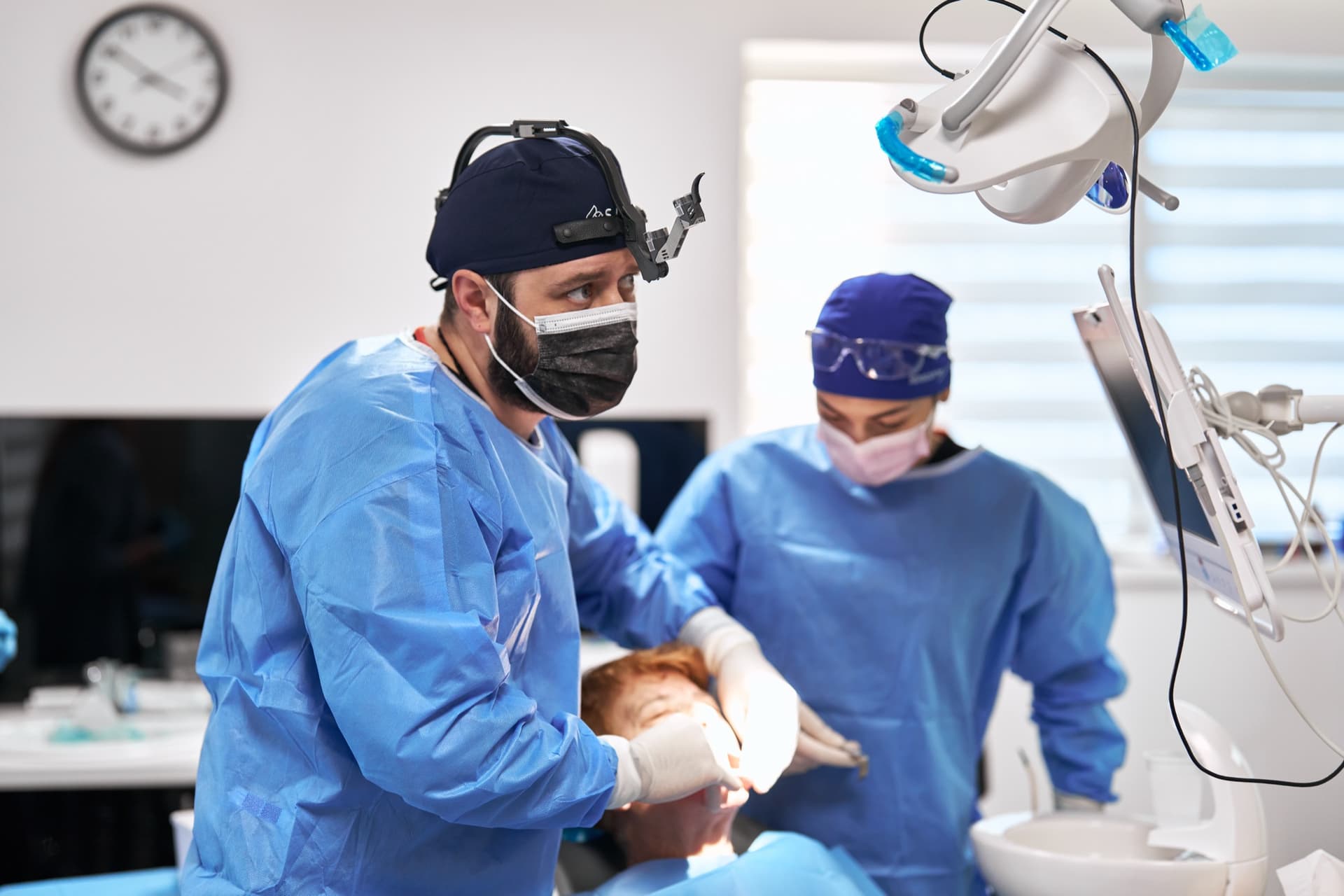
Oral surgery in Sibiu, performed with gentleness and precision


An extraction does not have to be a traumatic experience. At Infinite Smile, dento-alveolar surgery is performed under local anesthesia, included free of charge, with your X-ray taken on the spot, right in the clinic, and with an oral surgeon and implantologist who explains every step before taking it.
- Free local anesthesia, you feel no pain during the procedure
- In-clinic radiology, an immediate diagnosis, with no extra trips
- A dedicated oral surgeon and implantologist: Dr. Sergiu Rosca
- From simple extractions to impacted wisdom teeth, apicoectomies and sinus lifts
As featured in









- Medanet




- Sfat de Sănătate


- Ziarul Alb

- Media2
- The Business Lounge
What is dento-alveolar surgery
Dento-alveolar surgery is the branch of dentistry dealing with surgical procedures on the teeth and the bone that supports them: simple and complicated extractions, impacted wisdom teeth, apicoectomies, cyst removal, abscess drainage and preparing the bone for implants, from bone grafting to sinus lifts.
We know that for many patients the word “surgery” sounds frightening. The reality in the dental chair is far gentler: most procedures take between a few minutes and an hour, are performed under local anesthesia, so without pain, and by the next day most patients are back to their usual routine. The greatest fear is, almost always, before the procedure, not during it.
At Infinite Smile you also have an important practical advantage: radiology is performed right inside the clinic, with high-performance equipment and minimal exposure. The diagnostic X-ray is taken on the spot, the doctor sees the exact position of the roots, nerves and sinuses before operating, and you waste no time travelling to an imaging center.
When you need a dento-alveolar surgical procedure
Surgery is, as a rule, the last resort, whenever a tooth can be saved with a conservative procedure, our doctors prefer to save it. There are, however, situations in which surgery is the best (or only) solution:
- A tooth destroyed by decay or fractured below the gum line that can no longer be rebuilt
- Wisdom teeth that hurt, push against neighbouring teeth, decay repeatedly or have remained impacted in the bone
- Persistent infections at the tip of the root, a candidate for an apicoectomy
- Cysts of the jaw bones, usually discovered on an X-ray
- Abscesses requiring urgent incision and drainage
- Periodontally compromised teeth with severe mobility that can no longer be kept in the arch
- Baby teeth that do not fall out on time and block the eruption of permanent teeth
- Insufficient bone for an implant, solvable through bone grafting or a sinus lift
“I’m afraid of the extraction”, let’s talk about it openly
If you have been putting off an extraction for months out of fear, you are far from alone, fear of dental surgery is one of the most common reasons patients only see a doctor once the pain becomes unbearable. A few things, however, change the perspective.
First: a modern extraction does not hurt. Local anesthesia numbs the area completely, at Infinite Smile it is included free of charge. All you feel is pressure, a “pushing” sensation, without pain. The procedure only begins once the anesthesia has taken full effect, and if any discomfort appears, you raise your hand and the anesthesia is topped up.
Second: a simple extraction often takes just a few minutes, the longest part of the visit is frequently waiting for the anesthesia to set in. Delaying, on the other hand, complicates things: a compromised tooth can develop abscesses, can affect neighbouring teeth and turns a simple procedure into a laborious one.
Last but not least: who operates on you matters. At Infinite Smile, procedures are performed by Dr. Sergiu Rosca, oral surgeon and implantologist, who shows you your X-ray and answers all your questions before starting. When you understand exactly what is happening, fear drops considerably.
Wisdom tooth extraction
Wisdom teeth are the last teeth to erupt, usually between the ages of 17 and 25. In many people, the jaw simply has no room left for them: the molar remains partially or completely trapped in the bone (semi-impacted or impacted), erupts crooked or pushes against the neighbouring teeth.
A problematic wisdom tooth usually announces itself through pain and pressure at the back of the mouth, a swollen gum, repeated episodes of inflammation (pericoronitis) or decay on the neighbouring molar. Sometimes, however, it does not hurt at all, and the problem is only visible on a panoramic X-ray.
Removing a normally erupted wisdom tooth is an extraction like any other. When the molar is semi-impacted or impacted, a surgical extraction (odontectomy) is needed: the surgeon exposes the molar, removes it (sometimes sectioned into fragments to protect the surrounding bone) and closes the area with sutures. It sounds dramatic, but it is done under the same local anesthesia, you feel no pain, only pressure. At Infinite Smile, the surgical extraction of a semi-impacted molar costs 500 lei, and of a fully impacted molar 700 lei.
There is also a smaller procedure, the operculectomy: when the molar is erupting in a good direction but is covered by an inflamed flap of gum, the doctor removes only this flap and the molar can erupt normally.
Apicoectomy, a last chance for your tooth
Sometimes an infection at the tip of the root persists even after a correctly performed root canal, or cannot be resolved through retreatment, for example, when the canal is blocked by a post or by prosthetic work that is not worth dismantling. That does not automatically mean the tooth must be extracted.
An apicoectomy is the procedure in which the surgeon reaches the tip of the root surgically, removes a few millimetres of it together with the surrounding infected tissue, and seals the end of the canal. The tooth stays in the arch and functions normally, the problem is attacked right at the source, without sacrificing the tooth.
The procedure is performed under local anesthesia, through a small incision in the gum, and usually takes under an hour. The gum heals quickly, and the bone gradually rebuilds over the following months, progress is checked with follow-up X-rays, also taken in the clinic.
Cyst removal, abscess drainage and other procedures
Jaw cysts are fluid-filled cavities that most often develop around the root of a tooth with an old infection. They grow slowly and silently, they are often discovered by chance on a panoramic X-ray. Left untreated, they can weaken the bone and affect neighbouring teeth, which is why they are surgically removed (cystectomy) when detected.
An abscess, a painful, pus-filled swelling, sometimes accompanied by fever, is an emergency. The first-line treatment is incision and drainage: a short procedure under local anesthesia that evacuates the pus and relieves the pain and pressure almost immediately. The cause, the tooth or periodontal pocket that generated the infection, is then treated.
This area also covers preparatory procedures for dentures or implants, such as vestibular sulcus deepening, and the extraction of periodontally compromised teeth, teeth with severe mobility that gum disease has detached from the bone.
Sinus lift and bone grafting, preparing the ground for an implant
After a tooth is lost, the bone that supported it begins to resorb, it thins out and loses height. If you want an implant years after the extraction, the remaining bone may not be enough to anchor it securely. The good news: bone can be rebuilt.
Bone grafting means filling the deficient area with augmentation material, on which the body builds new bone. In the lateral area of the upper jaw, above the roots, lies the maxillary sinus, an air-filled cavity which, after tooth loss, “drops” and thins the available bone. This is where the sinus lift comes in: the sinus membrane is gently lifted and the space created is filled with bone material.
The sinus lift is performed in two ways, depending on how many millimetres of bone are missing: internal (through the same opening in which the implant is placed, for small deficits, 400 EUR at Infinite Smile) or external (through a small lateral window, for larger deficits, 700 EUR). After healing, the newly formed bone can safely receive the implant.
The clinic also offers implants from established systems, Bredent, Dentium, Megagen, INNO, JD (2,000–2,250 lei per implant), as well as full-arch restoration with the ALL ON X system (3,500 EUR). The entire journey, from extraction and bone reconstruction to the implant and the final restoration, happens in the same clinic, with the same team.
Who operates on you: Dr. Sergiu Rosca, oral surgeon and implantologist
Dento-alveolar surgery at Infinite Smile is performed by Dr. Sergiu Rosca, a graduate of the Universitatea de Stat de Medicină și Farmacie „Nicolae Testemițeanu” in Chișinău. In 2017 he obtained his Certification in Oral Implantology at UMF „Grigore T. Popa” in Iași, and since 2020 he has practised as an oral surgeon and implantologist.
His ongoing training includes specialist courses and congresses: the Advanced Implantology Course on the AlphaBio system (Israel, 2017), the “ImplantoDays” congress (Brașov), the “Megagen days” and “Plasmolifting Technology” courses, the “News in Periodontics” conference and the course “Team approach to implant placement, a surgical and prosthetic vision”.
The fact that the same doctor masters both surgery and implantology has a direct advantage for you: from the extraction onwards, the bone is preserved and prepared so that, if you later want an implant, the ground is as favourable as possible.
Healing after an extraction: what is normal and what is not
After an extraction, a blood clot forms in the socket (the tooth’s housing in the bone), the wound’s “natural dressing” and the foundation of healing. In the first 24–48 hours, light bleeding, discomfort that responds to the recommended painkillers and moderate cheek swelling are all normal. The gum usually closes within one to two weeks, and the bone rebuilds completely over a few months.
There is, however, one complication worth knowing about: dry socket (alveolitis). It occurs when the clot is lost prematurely, leaving the bone exposed. The telltale sign is the pain: instead of easing from one day to the next, it returns or intensifies 2–4 days after the extraction, can radiate towards the ear and is often accompanied by a bad taste and smell. Dry socket does not resolve on its own, return to the clinic, where the doctor cleans and dresses the socket; relief comes quickly after treatment.
The risk is higher for smokers, for patients who rinse vigorously in the first days and after laborious extractions. The best prevention is following the post-extraction instructions below, they exist precisely to protect the clot.
After your extraction, the first days, in short
At the end of the procedure you receive instructions from your doctor, tailored to your case. The general rules, however, are these:
- Bite firmly on the gauze placed by the doctor for 30–60 minutes
- Do not rinse, spit or drink through a straw for the first 24 hours, you are protecting the clot
- Do not smoke for at least 48–72 hours; smoking is the main risk factor for dry socket
- Apply a cold compress to your cheek, in 10–15 minute intervals, on the first day
- Eat only after the anesthesia wears off, soft, lukewarm foods, on the opposite side
- Avoid intense physical effort, saunas and alcohol for the first 2–3 days
- Take your medication exactly as prescribed; do not take aspirin on your own initiative
- Brush your other teeth normally, gently avoiding the extraction site in the first days
- If the pain increases after the second day, the bleeding does not stop or you develop a fever, call the clinic
How a surgical procedure unfolds, step by step
From the first consultation to the final check-up, you know at every moment what comes next, no surprises.
- 1
Surgical consultation and X-ray
The oral surgeon examines you and takes the necessary X-ray right in the clinic, periapical or panoramic, as needed. You look at the image together, learn what the procedure involves, what alternatives exist and what it costs, before deciding anything.
- 2
Local anesthesia, free of charge
The area is completely numbed with local anesthesia, included in the price at Infinite Smile. The procedure only begins once the anesthesia has taken full effect, you feel no pain, only pressure.
- 3
The procedure itself
A simple extraction usually takes a few minutes; a surgical extraction or apicoectomy takes longer, but rarely over an hour. The doctor tells you what he is doing; if you need a break, just raise your hand.
- 4
Clear post-operative instructions
You go home with precise instructions: how to protect the clot, what to eat, what medication to take and which signs warrant a call to the clinic. If sutures were needed, you learn exactly when to return to have them removed.
- 5
Check-up and suture removal
At the check-up, the doctor verifies healing and removes any sutures, a short, painless procedure. This is also when you discuss, if needed, the next step: replacing the extracted tooth with an implant or prosthetic work.
How much dento-alveolar surgery costs
- Surgical consultation
- 150 lei
- Local anesthesia
- free
- Periapical X-ray
- 30 lei
- Panoramic X-ray (OPT)
- 90 lei
- Extraction of mobile baby teeth
- 100 lei
- Extraction of non-mobile baby teeth
- 150 lei
- Single-rooted tooth extraction
- 180 lei
- Multi-rooted tooth extraction
- 220 lei
- Wisdom tooth extraction
- 350 lei
- Extraction with alveolotomy
- 300 lei
- Extraction of periodontally compromised teeth
- 100 lei
- Surgical extraction of semi-impacted molar
- 500 lei
- Surgical extraction of impacted molar
- 700 lei
- Operculectomy
- 50 lei
- Apicoectomy, single-rooted tooth
- 300 lei
- Apicoectomy, multi-rooted tooth
- 400 lei
- Cystectomy
- 400 lei
- Periodontal abscess treatment (incision and drainage)
- 100 lei
- Gingival curettage (per tooth / root)
- 50 lei
- Bone grafting
- 100 lei
- Vestibular sulcus deepening
- 100 lei
- Internal sinus lift
- 400 EUR
- External sinus lift
- 700 EUR
- Plasmolift treatment
- 120 EUR
- Dental implant (Dentium / INNO)
- 2,000 lei
- Dental implant (Bredent / Megagen / JD)
- 2,250 lei
- ALL ON X system
- 3,500 EUR
Prices valid from 04.01.2023. Emergency cases may involve additional costs, ask your treating doctor for details.
You can pay in installments through tbi bank, with no down payment, see our financing options.
Take the first step toward a healthy smile
From 180 lei (single-rooted tooth extraction)
Frequently asked questions
Does a tooth extraction hurt?
No, the procedure is performed under local anesthesia (free at Infinite Smile), which numbs the area completely. You feel only pressure, not pain. Once the anesthesia wears off, moderate discomfort for a few days is normal and is managed with the recommended painkillers.
How long does healing take after an extraction?
The worst of the discomfort passes in 2–3 days, the gum closes within one to two weeks, and the bone rebuilds completely over a few months. After a simple extraction, most patients are back to their usual activities the next day.
What can I eat after an extraction?
On the first day: soft, lukewarm foods, cream soup, yoghurt, purée, chewed on the opposite side. Avoid hot, hard or spicy foods and alcohol. Eat only after the anesthesia has worn off, so you do not bite your cheek. You can gradually return to your normal diet within a few days.
When are the sutures removed?
If the procedure required sutures, the doctor tells you at the end when to come back, usually after about 7 days, depending on the procedure and how quickly you heal. Removing them takes a few minutes and does not hurt.
Does a wisdom tooth always have to come out?
Not always. A correctly erupted molar that can be kept clean and does not affect neighbouring teeth can stay in the arch. Extraction is recommended when the molar hurts, becomes repeatedly inflamed, decays, pushes against neighbouring teeth or is impacted in an unfavourable position, the decision is made on a panoramic X-ray, taken on the spot in the clinic.
What is an impacted wisdom tooth, and what is an odontectomy?
An impacted molar has remained fully or partially trapped in the bone and never erupted. An odontectomy is the procedure in which it is surgically exposed and removed, under local anesthesia. At Infinite Smile it costs 500 lei for a semi-impacted molar and 700 lei for a fully impacted one.
What is dry socket and how do I recognize it?
Dry socket (alveolitis) is inflammation of the socket that occurs when the clot formed after the extraction is lost prematurely. The typical sign: pain that returns or intensifies 2–4 days after the extraction, instead of easing, often with a bad taste and smell. It does not resolve on its own, return to the clinic, where the doctor cleans and dresses the socket.
How can I prevent dry socket?
Protect the clot: do not rinse, spit or drink through a straw for the first 24 hours, do not smoke for at least 48–72 hours and do not touch the area with your tongue or fingers. Smoking is the main risk factor, putting off cigarettes for a few days significantly improves your chances of trouble-free healing.
What is a sinus lift and when is it needed?
A sinus lift raises the membrane of the maxillary sinus and adds bone material when the bone in the lateral area of the upper jaw is too thin for an implant. It is done internally (small deficits, 400 EUR) or externally (large deficits, 700 EUR). After healing, the newly formed bone can safely receive the implant.
What is an apicoectomy and when is it recommended?
It is the surgical removal of the tip of the root together with the surrounding infected tissue, when an infection persists after root canal treatment or retreatment is not possible. The tooth stays in the arch, it is an alternative to extraction. It costs 300 lei for single-rooted teeth and 400 lei for multi-rooted ones.
What do I replace the extracted tooth with?
Most often with a dental implant, the clinic works with the Bredent, Dentium, Megagen, INNO and JD systems (2,000–2,250 lei per implant), or with prosthetic work; for full arches there is the ALL ON X system. The doctor presents your options at the post-extraction check-up.
Oral Surgery in Sibiu, Romania
You will find the Infinite Smile clinic at Str. Dorului 11 in Sibiu, open Monday to Friday, with X-rays taken in-house. Book online or give us a call.
Infinite Smile · Str. Dorului nr. 11, Sibiu 550352 · 0369 409 116
Monday – Thursday: 08:00 – 20:00 · Friday: 08:00 – 16:00
See the clinic on Google Maps →Take the first step toward a healthy smile
Book a consultation at Infinite Smile Sibiu, smile and love with us.
Online booking in 2 minutes · Mon–Thu 08–20, Fri 08–16